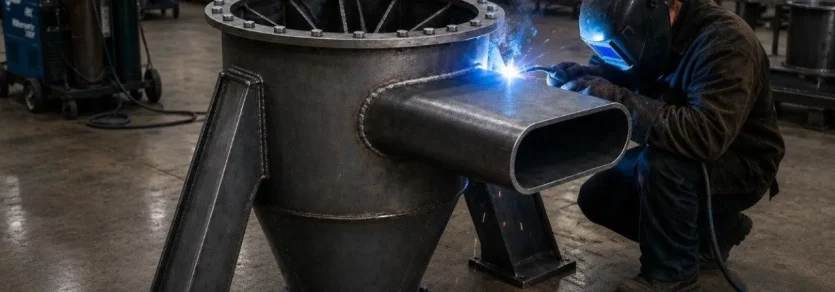
Loading Assembly Reverse Engineering for Baltic Facility
Case Study: Reverse Engineering and Manufacturing of a Loading Assembly for an Industrial Facility in the Baltic Region
Background
In early 2025, our company received a request from a contractor responsible for maintaining an industrial facility in the Baltic region. During scheduled maintenance of a bulk material conveying line commissioned in the late 1980s, critical wear was discovered on the distribution loading spout and transition chamber.
The situation was complicated by several factors. The original equipment manufacturer (OEM) was no longer in business, the original engineering drawings existed only as archived paper copies, and the actual geometry of the assembly had significantly diverged from the original design after decades of repairs and modifications. At the same time, prolonged downtime of the production line would have resulted in substantial financial losses for the customer.
On-Site Inspection
Our engineering team visited the facility and carried out a comprehensive inspection, including wall thickness measurements, manual dimensional verification of all mounting interfaces, photographic documentation of welded joints, and comparison of archived drawings with the existing assembly.
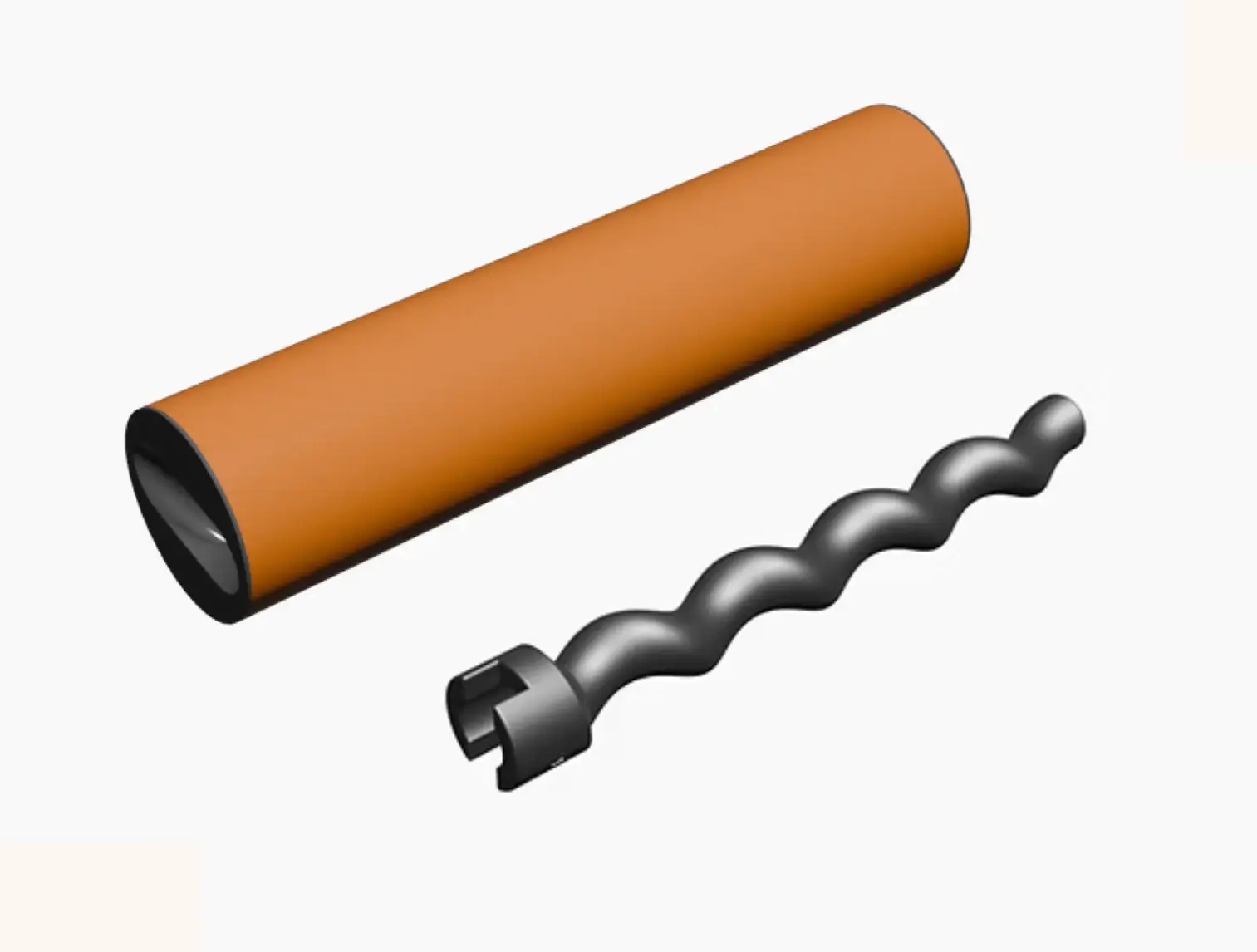
Particular attention was paid to the flange connections, internal guide ribs, the transition from the cylindrical inlet to the oval discharge section, and the reinforced support structure. Since reliable engineering documentation was unavailable, the component was reconstructed using reverse engineering based on the existing assembly.
Engineering
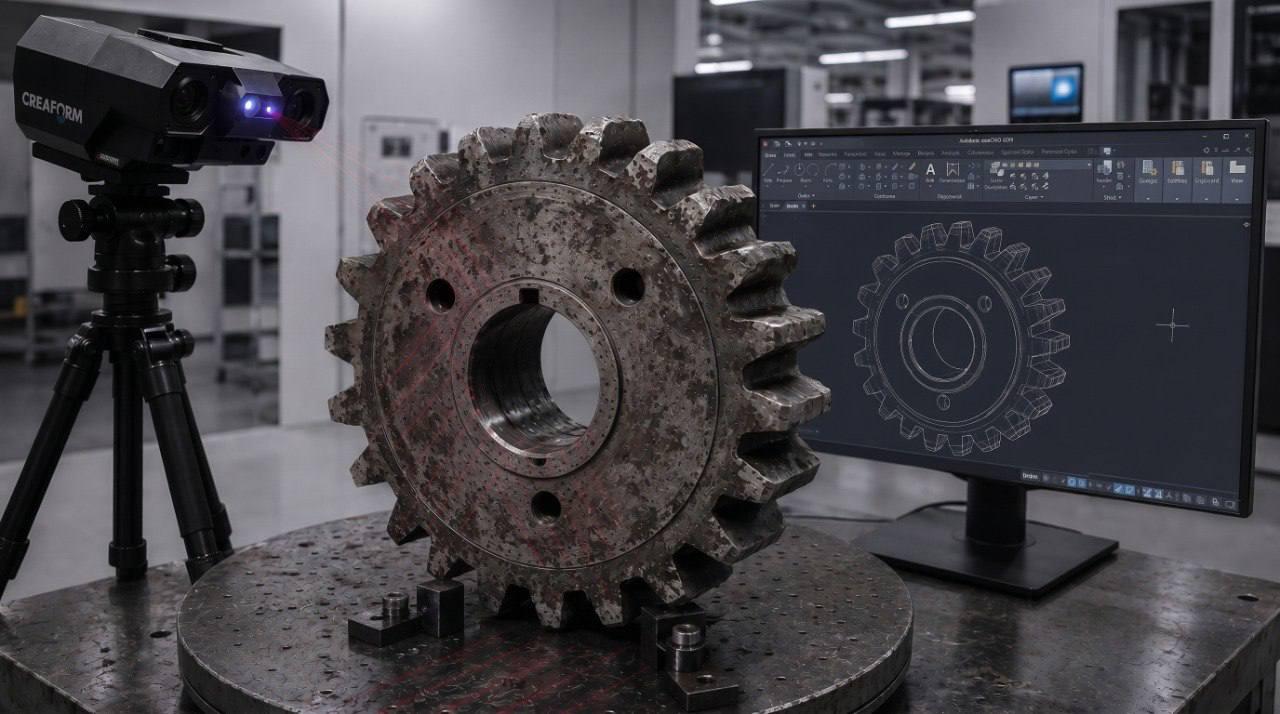
Our design department digitally reconstructed the assembly and developed a new CAD model based on the actual measured dimensions. Areas exposed to increased vibration were reinforced, the internal stiffening system was redesigned to reduce deformation during the handling of abrasive bulk materials, and the overall design was optimized for modern plasma cutting and welding technologies.
Manufacturing
The assembly was manufactured at our production facility using S355 structural steel. The manufacturing process included CNC plasma cutting, forming of the transition section, semi-automatic MIG/MAG welding, and precision machining of the flange surfaces.
The most technically challenging stage was manufacturing the transition from the cylindrical chamber to the oval outlet while maintaining perfect alignment and dimensional accuracy. After fabrication, the assembly underwent dimensional inspection, weld quality verification, and trial fitting of all connecting interfaces.
Result
The customer received a fully restored loading assembly featuring an upgraded design with an extended service life, together with a complete set of engineering drawings and a 3D CAD model for future maintenance and manufacturing.
The assembly was delivered within the agreed schedule and successfully integrated into the existing production line without requiring any modification of the mounting interfaces—all despite the complete absence of original factory documentation.