How can a worn part be restored when the original factory documentation is missing? This is one of the common questions Rotors Tech receives from technical departments at industrial companies.
Equipment can remain in operation for years, while drawings for individual units and components may be lost, outdated or only partially available. In this situation, manufacturing a new part is possible, but the process should not be treated as simple copying. It is a full engineering task.
At Rotors Tech, we restore worn parts from samples using reverse engineering: we measure the current condition, assess defects, verify the material, restore the geometry and prepare documentation for production.
Why a Worn Part Cannot Be Copied Directly
At first, it may seem enough to measure the old part and manufacture a new one with the same dimensions. In practice, a worn sample no longer fully represents the original geometry.
During operation, a component may develop:
- wear on seating surfaces;
- deformation of working areas;
- cracks and fatigue damage;
- erosion or corrosion;
- damage to threads, slots or edges;
- changes in symmetry and shape.
If these defects are transferred to the new component, the same problem may repeat. That is why the purpose of reverse engineering is not to copy the damage, but to understand what the part was originally designed to be.
Where the Restoration Process Starts
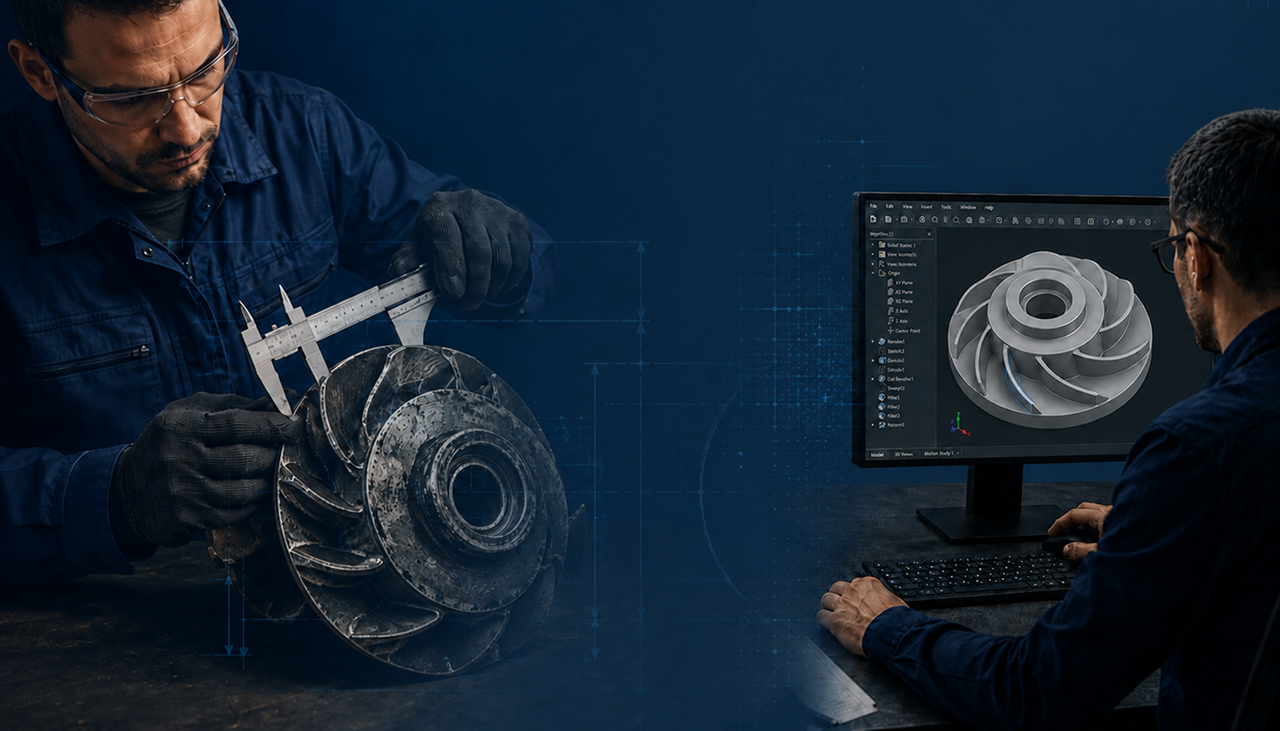
The first stage is measurement and documentation of the actual condition of the sample. Engineers define the dimensions of seating surfaces, diameters, threads, keyways, radii and other functional elements.
At this stage, the data is recorded “as found”. This is important because the first task is to build an objective picture: which areas still reflect the original shape, and which areas have changed during operation.
After that, specialists determine which surfaces can be used as reference points. Not every area of a worn part is suitable for geometry restoration. Some elements can serve as a reliable basis for reconstruction, while others only show the result of wear.
How Reverse Engineering Is Performed
At Rotors Tech, the restoration of a worn part follows a step-by-step process. This approach reduces the risk of errors and makes it possible to provide not only a new part, but also complete technical documentation.
The main stages are:
- Measurement of the actual sample dimensions.
- Assessment of wear, deformation and damage.
- Identification of reference surfaces.
- Material and hardness analysis when required.
- Restoration of the original geometry.
- Preparation of drawings and production documentation.
This process is especially important for parts used in pumps, turbines, compressors, rotors and other industrial equipment.
Why Material Analysis Matters
When factory documentation is missing, it is not possible to reliably identify the alloy grade, hardness or heat treatment condition by visual inspection alone. At the same time, the material directly affects strength, wear resistance and service life.
In such cases, material analysis is performed. It may include alloy grade identification, hardness measurement and, if needed, additional structural examination.
The same steel can have different properties after different heat treatment cycles. For critical components, it is important to restore not only the shape, but also the correct material specification.
How the Original Geometry Is Restored
After measurement and analysis, engineers move to geometry restoration. This is based on unworn areas, design logic, symmetry and an understanding of how the component works inside the unit.
| Stage | What We Do | Result |
| Measurement | Record actual dimensions | Sample data |
| Defect assessment | Identify wear and damage | Understanding of the part condition |
| Material analysis | Check alloy and hardness | Production data |
| Geometry restoration | Reconstruct the original shape | Model or drawing of the part |
| Documentation | Prepare technical data | Basis for manufacturing |
The main goal is to create a part that meets functional requirements instead of repeating the wear of the old sample.
What the Customer Receives
The result is not only a restored or manufactured part. The customer also receives a set of documentation that can be used in the future.
This documentation may include dimensions, tolerances and fits, surface finish requirements, material grade, heat treatment requirements and other production parameters.
It helps manufacture similar parts faster in the future, plan repairs and reduce dependence on missing factory drawings.
When Part Restoration Is Needed
Reverse engineering from a sample is suitable when:
- factory documentation is lost;
- drawings are incomplete or outdated;
- the original manufacturer no longer supplies the part;
- a component must be restored from a damaged sample;
- documentation is needed for repeat manufacturing.
Rotors Tech helps restore worn industrial parts from samples and prepares documentation for future production, repair and maintenance.