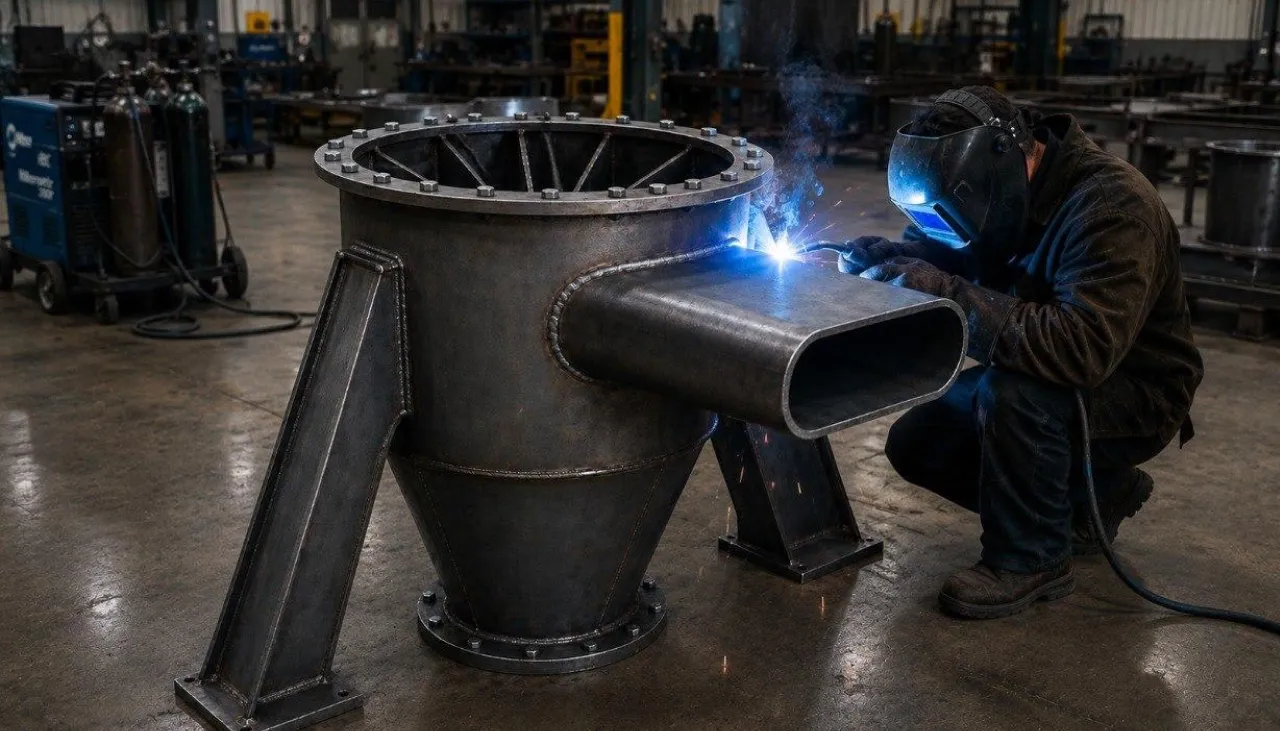
Rotors Tech has carried out the reverse engineering and manufacturing of a distribution loading unit for an industrial site in the Baltic region.
The unit came from a bulk-material conveyor line built in the late 1980s. During planned maintenance, the contractor found critical wear on the loading pipe and its transition chamber. Buying an original replacement was not an option: the equipment maker no longer exists, and the only surviving documentation was a set of old paper drawings that no longer matched the part after decades of service and repairs.
Our technical team carried out a full inspection on site — metal thickness checks, hand measurement of the mating dimensions, photo documentation of the welded joints, and a comparison of the archive drawings with the actual unit. Because no reliable documentation was available, the unit was rebuilt by reverse engineering from the existing sample.
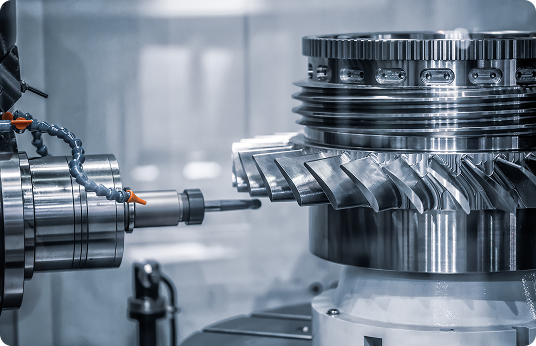
The design department produced a digital reconstruction and a new CAD model based on the real dimensions. High-vibration zones were reinforced and the internal stiffening ribs were redesigned to reduce deformation when handling abrasive materials. The unit was manufactured from S355 sheet steel using plasma cutting, forming of the transition channel, MIG/MAG welding and flange machining.
The rebuilt unit was delivered on schedule and integrated into the existing production line with no changes to the mating seats. The customer also received an up-to-date set of drawings and a 3D model for future maintenance.